



The automotive industry has been the South’s largest job and investment industry for decades. Here’s the latest news from the Southern Automotive Corridor.
Alabama
Hyundai spending half-a-billion at Montgomery vehicle plant
In the fall quarter, Hyundai Motor Company President and CEO Jose Munoz announced the Korean automaker will invest about $500 million at its assembly plant in Montgomery, Ala. The investment is being made to build new engines and other components, but the main gig will be bringing the Hyundai Tucson hybrid model production from South Korea to Alabama, bypassing the 15 percent tariff fee on imports. Shortly after production of the Tucson hybrid begins, the automaker will also bring assembly of the Santa Fe hybrid model.
Georgia
Audi to establish first U.S. production site in Georgia
By Michael C. Randle
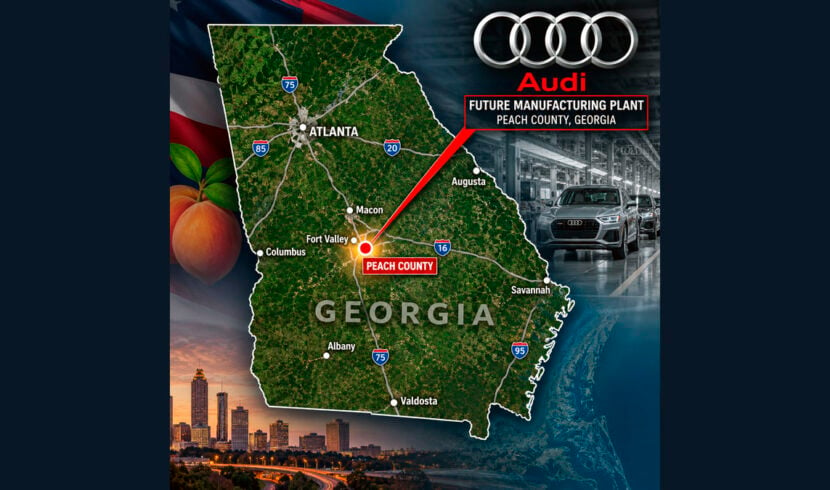
Audi is taking a major step in its global growth strategy with plans to establish its first U.S. production site in Georgia. The company intends to invest around $4 billion and create approximately 4,500 jobs.
Construction of the plant, designed for an annual production capacity of up to 200,000 vehicles, is scheduled to begin in 2027, with production planned to start in the early 2030s. With premium SUVs tailored to North American customers and manufactured locally, Audi aims to unlock significant growth potential in one of the world’s most important premium markets.
The planned investment intends to mark a long-term commitment to the United States and to establish North America as a third major pillar of Audi’s global production network alongside Europe and China.
Regarding the new multi-billion greenfield project at the Middle Georgia Mega Site, Gernot Dollner, Chairman of the Board of Management for Audi AG said “We have much greater ambitions for Audi in America. The United States is one of the world’s most important premium markets, and we have not yet realized our full potential.
“We are determined to change that – with premium products, a stronger brand and a competitive local production base. This is about building a stronger Audi business in America – not only about building a factory,” said Chairman Dollner.
Georgia Gov. Brian Kemp said, “We are proud that Audi has selected Georgia as the home of their first U.S. manufacturing facility, delivering truly historic investment and jobs to middle Georgia. Following the success we’ve enjoyed with other megasites, we purchased and made more improvements to the Middle Georgia Megasite for just this purpose: to bring a job-creating, high-caliber automotive manufacturer to this region.
“I want to thank the countless professionals from Peach, Macon-Bibb, and Houston counties in the Mid-Georgia Gateway JDA who helped make this happen. We are excited for hardworking Georgians in Peach County and the entire middle Georgia region to benefit from this project for decades to come. On behalf of the State of Georgia, we are honored to welcome Audi to our state!,” said Gov. Kemp.
Blue Bird expanding manufacturing footprint in Fort Valley, Peach County, Ga.
School bus manufacturer Blue Bird will expand its long-time plant in Fort Valley, Ga. The company has made school buses in Middle Georgia for nearly a century. The company is investing about $300 million in a new facility that will house 375 workers
Hyundai investing $560 million to add third plant in Georgia
Hyundai Transys is spending about $560 million to expand its West Point, Ga. manufacturing capacity. The deal, announced in October, will create 320 new jobs.
Plans include building a third manufacturing plant at Kia’s massive facilities in West Point, Ga., located on the Alabama-Georgia border. Hyundai is Kia’s parent company (both South Korean-based) as it owns over 35 percent of Kia.
The expansion is designed to increase production capacity for electrified powertrains used in hybrid vehicles made by both Kia and Hyundai at their plants near Savannah, (2,000 jobs currently with plans for 8,000 at build out); LaGrange, Ga. (3,000 employees); and in Montgomery, Ala. (4,200 employees).
Pirelli to invest $1.2 billion to expand in Georgia
In the fall quarter, tire producer Pirelli announced it will invest $1.2 billion in its existing facility in Rome, Ga. The major deal will create 1,000 new jobs. Headquartered in Italy, Pirelli located its U.S. headquarters and manufacturing facility in Rome, Ga. in 2002. Pirelli currently employs 234 Georgians through its manufacturing, innovation, and headquarters operations in the state.
Kentucky
Ford commits another $1 billion to Kentucky Truck Plant
Ford’s Louisville Truck Plant is getting a new paint shop. And it is spending $1 billion to do it. Ford Motor Co. announced plans to build a new $1 billion state-of-the-art paint shop at the Kentucky Truck Plant, replacing the facility’s existing shop and further modernizing Ford’s largest U.S. manufacturing plant. The company plans to break ground on the project by the end of 2026.
The announcement builds on Ford’s recent investments across the commonwealth, including approximately $2 billion for the transformation of the Louisville Assembly Plant into the future home of Ford’s new Universal EV Platform and approximately $2 billion at Ford Energy Systems in Glendale. That facility will manufacture battery energy storage systems. The Kentucky Truck Assembly plant in Louisville is Ford’s largest and most profitable U.S. manufacturing plant, where a truck rolls off the assembly line every 45 seconds.
Ford to build new vehicle in Louisville
In the early fall 2026 quarter, Ford announced it will build the new Ford Fathom with a starting price of about $30,000. The Universal Electric Vehicle platform is set to enter production in 2027 at the Louisville Assembly Plant. Ford is investing $2 billion at the Louisville plant to make room for the new electric pickup truck.
Battery manufacturer breaks ground in Louisville
Anthro Energy, an advanced materials and battery developer, celebrated the groundbreaking of the company’s first Kentucky operation, a new, $40 million manufacturing facility in Louisville. The deal will create 110 full-time jobs in addition to 390 construction jobs. The company makes batteries for all kinds of industries, including automotive.
Japanese auto parts supplier expands in Owensboro, Ky.
Toyotetsu Mid America is expanding its parts factory in Owensboro. The $41 million investment will retain 640 jobs. TTMA, which has operated in Owensboro for 25 years, will be upgrading its operational capacity and equipment to remain competitive in the automotive industry.
Auto tech firm announced big deal in Owensboro, Ky.
Astemo Americas announced a more than $112 million expansion project at its Madison County operation, creating 114 new Kentucky jobs. The company is a major player in the EV manufacturing sector.
Mississippi
Auto parts manufacturer creating jobs in Mississippi
Automotive parts manufacturer Solero Technologies is expanding its operations in Water Valley. The project represents a corporate investment of more than $14 million and will create 86 new jobs. Solero Technologies is a leading global supplier of actuator and solenoid valve solutions for the automotive industry and other industrial sectors.
North Carolina
Toyota Battery has reached 50 percent buildout with nearly 2,800 workers in North Carolina
Toyota Battery Manufacturing North Carolina (TBMNC) in Liberty, N.C. has reached 50 percent buildout with nearly 2,800 workers in its quest of 5,100 workers by 2034 with the completion of the plant. The completion of the plant depends heavily on consumer demand for electric and hybrid vehicles. To date, most employees live in Guilford and Randolph Counties, with others commuting from Forsyth, Alamance and other surrounding counties.
Chinese automotive parts manufacturer brings first U.S. plant to Charlotte area
Xingyu Automotive Lighting is locating its first Southern Automotive Corridor plant in Rowan County, which is located in the Charlotte metro. The company plans invest $50 million in the first phase and hiring at least 300 workers in the deal.
Daimler Truck opens Charlotte HQ
In the fall quarter, Daimler Truck Financial Services opened its $8 million headquarters operations in Charlotte. The truck maker is consolidating its Detroit and Fort Worth, Texas operations to the Queen City and hiring 350 in the deal.
South Carolina
Scout Motors CEO bullish despite parent VW’s problems
By Michael C. Randle
Scout Motors CEO Scott Keogh, needless to say, is giddy about the revived brand as it finalizes its new stake in its operations in North and South Carolina. In Blythewood, S.C., the company is finishing up its new assembly plant, only 76 miles from its new Charlotte headquarters in a historic 145,000-square-foot building at the Commonwealth development. There, the headquarters operation is expected to create 1,200 jobs. Currently Scout has about 200 employees at its headquarters in North Carolina.
At its 1,600-acre assembly plant in South Carolina, Scout prototypes have already been made. The body and paint shops are active, with 700 synthesized robots producing initial body structures.
The assembly plant in South Carolina is a $2 billion investment. It is expected to eventually house as many as 4,000 workers with an additional 1,000 supplier jobs. In October, at the company’s first Harvester Festival at Camp North End in Charlotte where prototypes were shown, Keogh said “The entire anchor of what we’re doing is bringing back an American brand for the American market, made by Americans, marketed by Americans, sold by Americans for Americans. So, we are firmly committed to industrializing America, and particularly here in the Carolinas.”
International Harvester built the truck-like-SUV from 1961 to 1980. In fact, while playing baseball in Florida, I purchased a 1980 Scout. It was a remarkable machine that was more truck than SUV, as International Harvester is known for heavy-duty 18-wheelers. I felt as if my Scout could climb buildings. It was that tough of a truck. Without an argument from anyone, Scout invented the first SUV in the 1960s.
Germany-based Volkswagen acquired the rights to the Scout brand when it purchased Navistar in 2021. VW revived the Scout brand in 2022 and announced the South Carolina factory shortly after. The plant will have an electric focus and will make several SUV models.
Parent company VW is facing significant business challenges that center on declining sales in key markets such as China and Europe. In those two continents, Chinese-built electric models, once a sideshow, are now being snapped up in short order, creating a huge slump in sales for VW. Volkswagen plans to eliminate 50,000 jobs worldwide as part of its restructuring efforts and is slashing half of its vehicle lineup. However, the new Scout brand looks as if it will be a big winner for Volkswagen.
Tennessee
Ultium cells will invest $1 billion in Spring Hill, Tenn.
Ultium Cells, a joint battery venture of LG Energy Solution and General Motors, announced in the fall quarter it will retool and diversify its Spring Hill battery cell manufacturing operations. GM and LG originally announced their joint venture in 2021 at the beginning of the EV frenzy that ran until 2024. The project has already created more than 1,000 jobs.
Manufacturer for many industries, including automotive, lands in Jackson, Tenn.
Pace Industries, a manufacturer of products for the defense, automotive and aerospace industries is setting up shop in Madison County, Tenn. The $10 million investment will create 100 jobs.
Texas
Toyota to begin first phase construction on $3.6 billion San Antonio plant
Japanese automaker Toyota will begin construction in December on a $200 million first phase of a $3.6 billion expansion of its South Side San Antonio assembly complex in December. The broader $3.6 billion plans will almost double the size of the plant that makes the popular Toyota Tundra pickup truck model and the SUV Sequoia. Toyota’s expansion will include a new large line for the Toyota Tacoma pickup. At buildout, the expansion will create 2,000 new jobs.