


By Michael C. Randle
There won’t be many political stories published on SouthernBusiness.com, so consider this a rare post.
There are all kinds of theories behind the “political extinction” event in November of 2026. According to one Republican governor, it was the end of an 11-year far-right political movement in the U.S.
“Extinction” was the description given by Florida Gov. Ron Desantis on a few cable news networks the evening of the midterm election results on November 3, 2026.
Some pundits on news shows cited corruption and the war in Iran as to why the pitchforks came out. Others pointed fingers at high gas prices, inflation in general, and other economic issues. Lots of folks blamed the brutal anti-immigration policies implemented by this administration for such a rout.
According to Gallup, 50 percent of average Americans polled cited two issues: the economy and health care at the top of the issue heap. Of course, we all know health care is a mess. The economy, sans inflation, is not in a mess. Not overall.
As for the economy, there is a lot to like and a lot not to like.
The good economy: Capital investment in new projects is at all-time highs in the region. Deals announced in the South have already broken records through three quarters of 2026 that have stood since the first SB&D 100 ranking was published in 1994.
End-of-year results, including state and overall regional projects meeting or exceeding SB&D’s thresholds, will be revealed at SEDR@RosemaryBeach at The Pearl Hotel December 10-12.
The numbers can’t help but look great when, after three quarters of this year, 601 big buffalo deals had been announced in the South. In 34 years, the most deals in any year (by our methodology) are 730 projects announced in 2015.
In 34 years, we have never achieved the 800 big deal threshold in the American South. That total is certainly in sight by the end of this year, unless the election results shut down the deal spigot for whatever reason, which doesn’t appear to be happening; deals have slowed, but not significantly since November 3.
As we near the end of November, we believe it is nonsensical that some of the half-built projects will not result in completion. There is just too much action happening, at least in the South, that’s not yet finished.
And so many hundreds of planned deals are on the drawing board; literally hundreds of billions worth. The real issue we see is a whopping 74 percent of projects announced so far in 2026 are A.I. and data center related. That’s a lot of eggs in one industry basket.
The bad economy: Prices, period, of everything. The price increases are in large part triggered by the tariffs that began shortly after April 2, 2025 — “Liberation Day,” remember?
I wrote on April 3, 2025, “The first thing you will see is disposable income drying up because the tariffs will raise prices naturally for just about everything. Then, you watch, restaurants will be dying off like flies.” And they have.
Sure enough, QSR.pro recently published a story about the restaurant industry. “The restaurant industry entered 2026 with a closure problem that is accelerating, not abating. Six major restaurant chains have announced plans to close hundreds of units this year, and data suggests the total number of closures across the full industry could be the highest since the pandemic.”
Black Box Intelligence supported that claim by QSR.pro. Black Box warned that up to 20 percent of all restaurants in the U.S. could close by the end of the year.
Well, it’s been 20 months since “Liberation Day.” There is zero question that the tariffs implemented, then not, then implemented again, and so forth, have raised prices on everything from vehicles to clothing to food and fuel.
What I believe caused the “blue wave” more than any one issue
While the economy, health care and the situation in Iran were all issues seen at the top of the Gallup poll, right beneath those at 47 percent was this: Income and wealth distribution. Ah, income inequality.
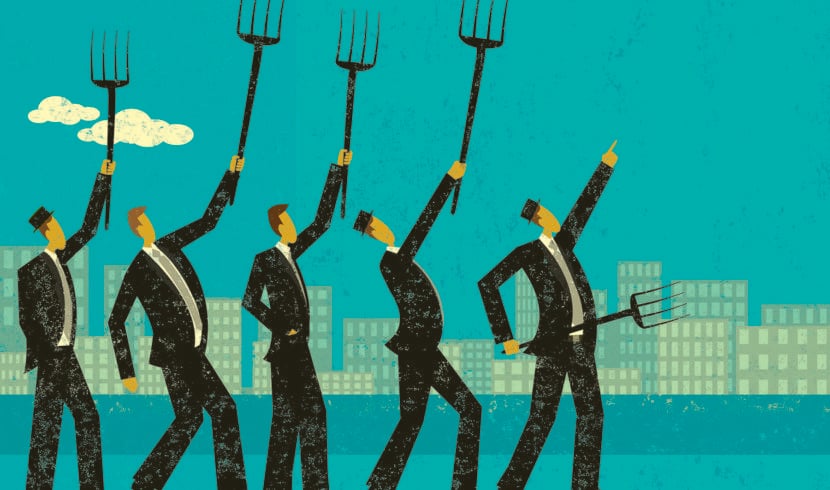
I am not an expert on politics, and I never want to be one. However, it sure seems to me that most Americans watched billionaires become even richer billionaires and one billionaire become a trillionaire almost overnight. All the while they saw their wages stagnate, failing to keep up with inflation. That kind of income inequality can only go so far with the public and eventually they will simply grab their pitchforks and exclaim, “Enough already!”
Most presidents over the years in this country knew this about voters; they vote with their pocketbooks. That election issue has been around this country for over 200 years, and I will argue it has been the No. 1 political issue for 200 years when affordability is in question.
In other words, forget about the little guy through political policies like tariffs and war, and you will pay at the voting booth. There are only about 300 million of those little guys in this country, and one percent of the population, if that, are true plutocrats.
Call it the domino effect. An A.I. search put it this way: “One thing leads to another”: ‘A common conversational idiom describing an initial action that sparks a sequence of subsequent, often unintended occurrences.’
In other words, one can easily see, with such vast gaps in income, a socialist response forming in the political sphere, or “unintended occurrences.”
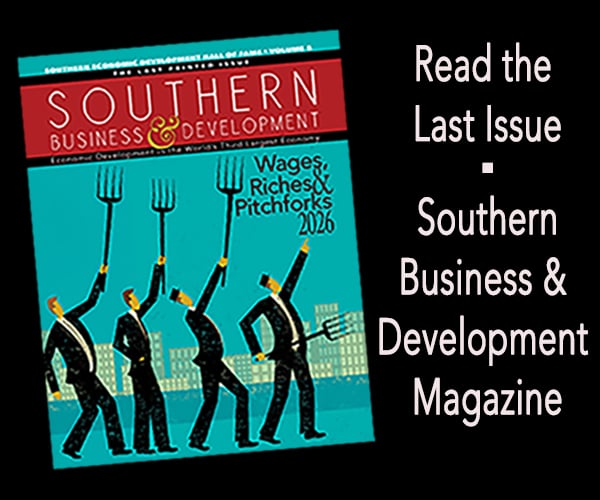
Like I wrote, I am no expert on politics. My last cover story in the last printed issue of Southern Business & Development magazine was titled “Wages, Riches and Pitchforks,” which can be read in a digital flipbook found on the landing page of this website, SouthernBusiness.com.
Top-down economics vs bottom-up economics
Let’s make it perfectly clear that we at SB&D do not fault the wealthy getting wealthier. That is capitalism, the foundation of this nation’s economy.
Then again, SB&D has never cheered on top-down economics. We have tried it with economic policies in the past and it has never worked, except for the already well-off. And it is not working now if the voting result is any indication. That is not a political statement; that is fact backed up by decades of data.
For decades, SB&D has been a proponent of “middle-out economics,” which focuses on the buying power of the middle class to create more jobs, investment and general overall growth.
Also, we support a “regional” increase in the minimum wage, as the lowest wages should be higher in places like California and New York compared to many states in the South. We are certainly not the only ones supporting such an economic philosophy.
A long-time proponent of “middle-out economics” is Nick Hanauer, a very affluent entrepreneur based in the Seattle area. A self-described “plutocrat,” Hanauer was the first non-family member to invest in Amazon. He has founded companies that have been purchased by Microsoft, Boeing and Trulia.
Today, Hanauer runs a venture capital company that “looks to invest in promising teams and transformational ideas in a wide range of areas. These areas include the internet, social and consumer media, software and clean energy.” Hanauer is a vocal advocate of increasing the “regional” minimum wage across the U.S.
Hanauer claims that “trickle-down” economics should be replaced with support for the middle class because “every place on Earth where you find prosperity, you find massive investments in the middle class and the poor.”

Nick Hanauer’s TED Talk
I wrote my first “Wages, Riches and Pitchforks” story in 2016 because of a TED talk I heard from the entrepreneur Nick Hanauer, again, a self-proclaimed plutocrat. He is a very wealthy guy. He saw a future of angry mobs with pitchforks in this country raging if something wasn’t done about income inequality.
During his talk he said, “While people like us plutocrats are living beyond the dreams of avarice, the other 99 percent of our fellow citizens are falling farther behind.” That was more than 10 years ago. Income inequality is worse today than it was then.
He also said, “So I have a message for my fellow plutocrats and zillionaires and for anyone who lives in a gated bubble world: Wake up. Wake up. It cannot last. Because if we do not do something to fix the glaring economic inequities in our society, the pitchforks will come for us, for no free and open society can long sustain this kind of rising economic inequality. It has never happened. There are no examples.
“You show me a highly unequal society, and I will show you a police state or an uprising. The pitchforks will come for us if we do not address this. It’s not a matter of if, it’s when. And it will be terrible when they come for everyone, but particularly for people like us plutocrats.”
Yes, the pitchforks came on November 3, 2026. What happens next is anyone’s guess at this point.