





Southbound
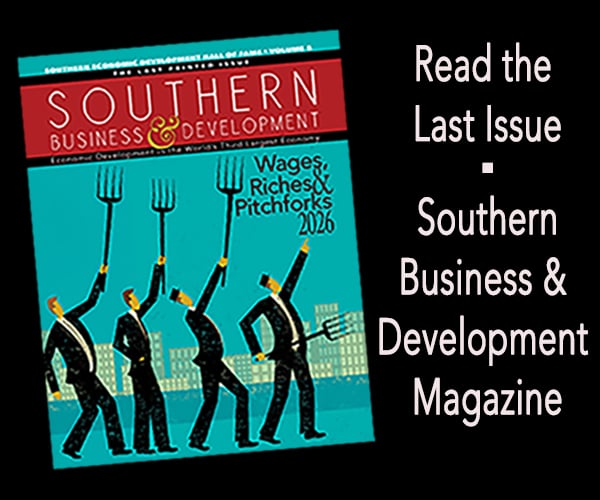
After almost 45 years, SB&D has ended its run of printing magazines and newspapers
By Michael C. Randle
Older folks still love to touch, see, feel and smell paper, especially very high-quality paper that we used here at SB&D for four decades. Younger folks? Not so much anymore. Folks under 45 would not read print if that was the only thing in the waiting room before a root canal. They just look at their phones. We get it and that’s why we printed our last print job this summer after 45 years.
Print is not part of the younger generation’s routine. Of course, there are hardly any more daily newspapers left in print. I still adore tackling The New York Times Sunday edition, all six pounds of it.
45 years of print with these hands
I don’t go back to the use of molten lead that would help Linotype machines cast entire lines of text. Each line was a solid metal slug. Each line! Pages were locked in to steel frames called chases and rolled onto presses. Can you imagine? That technology ended in the early 1950s. I wasn’t born yet.
I started this media company (the Birmingham Business Journal at the time) as a 20-something in 1982. I also missed 1950s to 1970s phototypesetting, a real step-up from molten lead. But even then, the X-Acto knife was used prominently in the process.
I grew up in print with paste-up boards and pure darkroom wizardry (“You opened the door to the dark room? Shame on you! Damn! Shoot ‘em again! Do we have any photo paper left?”).
Before InDesign, even Quark, printing prep was essentially a craft shop + chemistry lab.
Amberlith, Rubylith, X-Acto knives and registration marks (“Don’t bleed on the boards, dammit, and I mean it!”) were mere parts of the tools of the trade. You worked with serious metal rulers to line everything up.
There, we created — I created as the main layout artist after I launched the Birmingham Business Journal in 1982 — a tabloid-style newspaper. I wrote it, sold the ads, did “layout” and it was pure artistic magic at 3:00 am on a Sunday morning with zero digital involvement.
I also owned it and had to make payroll; tough to do as a 20-something. I wasn’t very smart, but I was determined!
Later, OMG, “Wordstar” was invented, before email existed. It was the most basic word processing function, but so much better than an electric typewriter. You could now take a floppy disc with your content straight to the typesetter. Glory Be!
Yup, you worked with cyan, magenta, yellow and black. No other colors. So, you had to mix the ink to make another color other than those.
“Hey Gladys, we need 30 percent magenta, 30 percent black, 10 percent cyan and 30 percent yellow for that, please,” which essentially were “four-pages-up” per “board” for a brownish-red, brick shade. “And do a 100 percent reverse for the type for that piece.”
Gladys: “Mike, I don’t like that color there.” Me: “Too late; passed deadline!”
But then, the most amazing thing happened. The dial-up fax machine was invented. Oh, my, you could use your tiny 8-inch screen computer with the memory of a smart German shepherd to send your content to the typesetter via the phone, not hand-deliver your work.
The folks creating that content, or, what we called, “copy,” they would deliver it to you in type strips that had to be hot-waxed, cut and formed and placed exactly on the page boards, again, using an X-Acto and a 2lb ruler. It was like an early version of Legos; just more difficult to build.
Content was not just written; it was built in the days of “publish or perish.” To this day, it is still “publish or perish” and I put that phrase on t-shirts with the BBJ logo on it 40 years ago. Because if you did not publish, you were not paid.
Then, you had to make all of those pages into negatives in photo form that would weigh about 80lbs for a 96-pager. Four negatives (one for each color) for each page. I cannot believe we did that for years, decades.
Then, after completion of the layout that took us about three weeks at best, you shipped the negatives to your $50 million German press house you were contracted with. Our last printer was based in Missouri. We have printed in Alabama, Ohio, Kentucky, Florida, Virginia and Tennessee over the five decades.
The dreaded mailing list
Mailing and maintaining a current mailing list, in our case for SB&D, site consultants and CEOs from up North, was a full-time job. Addresses were changed each month; people died, retired, moved to another job, etc. And you had to catch every single change to feel some finality to each issue. The last thing a publisher wanted was to send a $30,000 print job to a vacant office, a plant that was closed. Or to a person who had passed on. Yes, in print, you better keep up with every reader. It was just so much work.
So, we have “turned the page” to the new SouthernBusiness.com Finally, I lucked up. In 1997, when we designed our first news website, SB-D.com, Network Solutions wanted $1.5 million for the domain, SouthernBusiness.com. I checked on the price during COVID and it was still priced at $150,000. I bought it in 2024 for $1,500. Winner, winner, chicken dinner!
So, what you are reading now on this new site is the result of two years of planning to abandon print for the first and last time.
We are not sad about ending our print runs after nearly 45 years. In fact, we are so happy to go from monthly and quarterly deadlines to daily and hourly as our work is now completely digital.
Don’t get me wrong. We made money on print. But no one under 45 reads print. Those folks get their news on their phones. We get it, so it is time.
So, we ended an era of printing, not because printing our product is not profitable; it is.
But, I think almost 45 years of print with one owner is enough, don’t you?