Windsor Door Invests $21M in New Production Line at Little Rock Manufacturing Facility

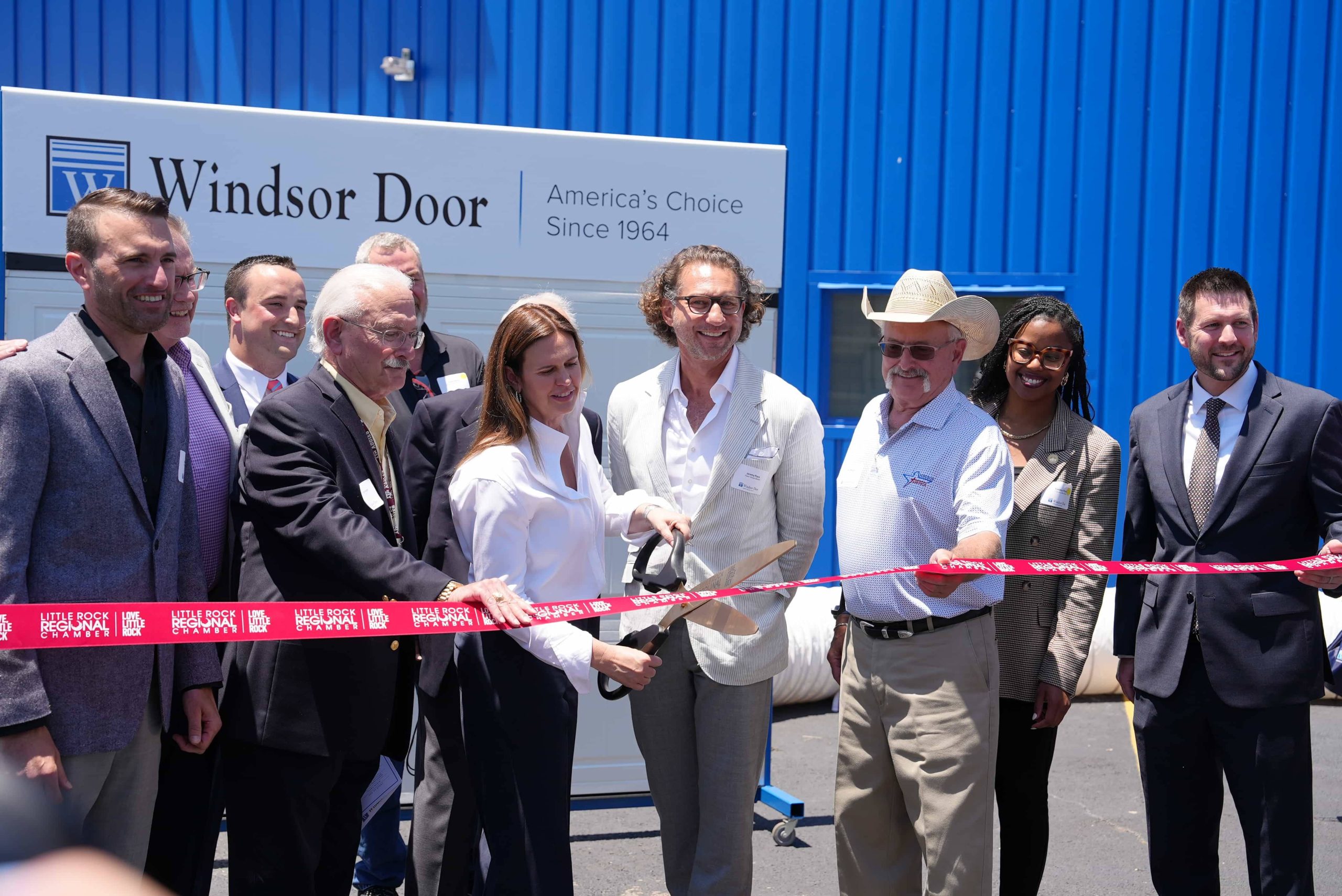
Windsor Door, a family-owned, leading manufacturer and distributor of residential garage and commercial sectional overhead door products, unveiled a new $21 million high-speed production line at its Little Rock plant Wednesday. This state-of-the-art line aims to enhance operational efficiency and expand production capacity to provide quality products that support home builder’s efforts to deliver affordable housing across the country.

“Since 1964, Windsor Door’s reputation has been renowned for building garage doors that are reliable,

functional and aesthetically appealing,” said Bob Strahan, President of Windsor Door. “This new production line signifies our commitment to drive innovation in our processes, products and responsiveness to customer needs.”

The new product features high-strength steel, heavier-duty construction, and sets a new standard for durability and performance.

In addition to meeting industry demands, the investment brings substantial economic gains for the community. At full capacity, the line doubles the plant’s output, creating numerous direct and indirect jobs in Arkansas and the 50+ metropolitan areas the company serves.

Arkansas EDC

How Japanese design and Texas culture is influencing Plano’s upcoming hotel near Toyota HQ

An upcoming grand and unique hotel in Plano has generated significant buzz around how exactly the project will fuse Japanese sophistication with big Texas, Southern-style charm.

The Miyako hotel, located on the south side of Campus at Legacy near Toyota’s North America headquarters, aims to not only cater to Japanese employees visiting the company, but also to a broader public looking for a special and authentic experience. It is expected to deliver in mid 2027. 

Garfield Public-Private LLC was recently announced as the developer for the hotel — five years after the project was first announced. The Dallas-based firm will be responsible for finalizing designs and permits to bring the hotel closer to the construction phase.

Dallas Business Journal

SomeraRoad reveals vision, new renderings for $1B Nashville Gulch project

SomeraRoad has big plans for Nashville — and the firm has divulged new details.

The firm, which was founded in New York and since opened a second headquarters in Music City, started with plans for two tower and the revitalization of two historical properties in the Gulch — the antique mall and the Voorhees Building.

Now, it’s first local project, dubbed Paseo South Gulch, is estimated to cost more than $1 billion and has grown in scale to four towers. Nashville Business Journal

Andrew Donchez, head of development at SomeraRoad, sat down with the Business Journal to discuss the company’s Gulch vision, revealing new details and renderings of one of the city’s largest development projects.

Nashville Business Journal

Williamson County, Tenn. preserves economic development funding, but expectations have changed

Nashville’s suburban headquarters hub will continue funding economic development. But priorities have changed, and even the county Republican Party isn’t happy about it.

On June 10, the Williamson County Commission approved a new one-year contract with Williamson Inc., the county’s economic development arm and chamber of commerce.

The $400,000 arrangement, which accounts for 30% of Williamson Inc.’s annual revenue, sustains a role the organization has played since it came into existence a dozen years ago.

The funding fight served as the latest flash point in a spreading backlash to growth. In the last two years, longstanding six-figure government contracts for economic development went away in Davidson and Sumner counties. For the last few months, Williamson Inc. has faced the same prospect, intensified by a twist: Commissioners had approved $400,000 of economic development funding in the budget, but the county contract had lapsed in mid-2023 and went undetected until now.

Nashville Business Journal

Texas attracted California techies. Now it is losing thousands of them

Back in the halcyon days of 2020, a year we all remember fondly, a new flash point opened in the enduring war between Texas and California. Technologists started picking up sticks in Taxifornia and moving to the Lone Star State in greater numbers. The enemy’s chief newspaper, the Los Angeles Timesworried that Silicon Valley’s “monopoly” was over and wondered if Austin was “the future.” Governor Greg Abbott declared Texas was “truly the land of business, jobs, and opportunity.”

In the wave of stories about Austin’s ascension in 2020, there were always two pieces of evidence given top billing. That year the tech goliath Oracle relocated its HQ to Austin, where it had already built a massive campus on the south shore of Town Lake, and Elon Musk began building a gargantuan Cybertruck factory just outside the city. Austin-area authorities helped Oracle secure valuable lakefront real estate and offered Tesla some $60 million in tax abatements, including $50 million from the historically struggling school district in Del Valle. The new facilities were greeted by state officials as evidence that the “Texas Miracle” was alive and well. Abbott proudly proclaimed last year that Austin was “THE destination for the world’s leading tech companies.”

This week saw a major plot twist in that narrative: Oracle declared it was moving its headquarters to Nashville, and Tesla—the largest private employer in the capital city—announced it would be laying off almost 2,700 workers from its Austin plant after a disappointing earnings report. Texas wasn’t really at fault here. Oracle, which makes business software, cited Nashville’s strength as a center of the American health-care industry, though it surely also helps that the company is getting nearly a quarter of a billion dollars in tax breaks and incentives from the city and the state of Tennessee. Tesla, meanwhile, laid off workers across the country after the Cybertruck suffered significant quality issues that put the future of its Austin production facility in doubt. The city’s debut in auto manufacturing is a vehicle that apparently rusts in the rain. The factory complex, which Musk once promised would become an “ecological paradise,” recently took advantage of a new state law to exempt itself from Austin’s environmental regulations.

Texas Monthly

LazeStar Inc. moves manufacturing operations to Williamson County, Tenn.

California-based LazeStar Inc. Tuesday announced plans to invest $5.5 million to relocate its manufacturing and laser welding operations to Fairview.

The arrival of the 23-year-old company will initially add 25 jobs to Williamson County with expectations to add up to 35 jobs, according to a news release from the state Economic and Community Development Department. At its April 14 meeting, the Fairview City Commission unanimously approved the rezoning of nearly 15 acres off Fairview Boulevard East for the LazeStar property, according to Main Street Fairview.

“LazeStar couldn’t be more excited about the relocation to Tennessee and specifically Fairview,” said CEO Michael Hartman in the release. “We are confident LazeStar is going to thrive in Tennessee. Being in a place that promotes business and supports our future is going to be a perfect match.”

Nashville Business Journal

Memphis-based FedEx plans to lay off up to 2,000 workers across major international market

Memphis-based FedEx Corp. intends to lay off up to 2,000 workers across Europe.

The company announced the plan on Wednesday, June 12. Its filing with the Securities and Exchange Commission (SEC) said the move to cut 1,700 to 2,000 jobs was an effort to “streamline its workforce in Europe as part of ongoing measures to reduce structural costs.”

The layoffs are currently in a proposal stage because they are “subject to local law and consultation processes,” the company said. Those consultations will occur separately in each country in which FedEx wants to cut workers and will proceed along different timelines over 18 months.

According to FedEx’s website, the company began its service to Europe in 1984. It currently employs more than 52,000 people there and has three regional hubs across the continent. Its European operation, which serves 45 countries and territories, is headquartered in Hoofddorp, The Netherlands.

FedEx estimates the pre-tax cost of the layoffs, including severance benefits, to be $250 million to $375 million in cash. The expenses would be incurred through fiscal year 2026. Annualized savings starting in FY 2027 are expected to be $125 million to $175 million.

Memphis Business Journal

Cambro starts construction on East Coast logistics base in Mebane, N.C.

The 300,000 to 400,000 parts made a week at the Cambro Manufacturing plant in Mebane might sound like a lot, but it’s less than half what’s made at the company’s home base in California.

But Mebane is catching up.

Construction has started on a 380,000 square-foot distribution facility that will enable the Huntington Beach, California-based maker of food-service equipment to move logistics operations from its nearby facility and add manufacturing space. It’s expected to in operation sometime next year with 60 employees added over four years, on top of the 145 and growing headcount at the present site.

Triad Business Journal

Leggett & Platt to close High Point, N.C. furniture plant, cut 158 jobs

Furniture component maker Leggett & Platt plans to cut 158 jobs in High Point, the company told the North Carolina Department of Commerce.

The company plans to close its manufacturing operation at 1629 Blandwood Drive. The elimination of jobs will be permanent, the company said.

Leggett & Platt said it expects the first release of employees to be on or about July 25, and the rest by the end of September.

They include 134 in production and production support, nine among clerical and administrative workers, and 15 in management. The company is exploring several sources of outplacement assistance.

The notification, dated May 20, was posted Tuesday on the Department of Commerce website.

Leggett & Platt is based in Carthage, Missouri. It makes components and supplies for bedding, furniture, flooring, home textile products, and seat components and systems for the auto and aerospace industries, as well as hydraulic cylinders for material handling, transportation and heavy construction equipment.

Triad Business Journal

Arrival, the EV maker that failed to deliver on big promises in Charlotte, declared bankrupt

Arrival, the electric vehicle startup that made significant commitments in the Charlotte region, is bankrupt after years of financial struggles.

The company announced this week that it filed for bankruptcy on May 16 in Luxembourg, where Arrival is based. Arrival was declared bankrupt by a Luxembourg court on May 22. The disclosure came after Arrival sold its manufacturing assets in the U.K. and U.S. to Torrance, California-based Canoo Inc.

Arrival implemented several cost-cutting plans since 2022. It also had its shares suspended and delisted from the Nasdaq exchange earlier this year. Arrival revealed in late 2023 that it had secured bridge financing to pursue a sale of its assets. The company’s spiral culminated with its bankruptcy filing.

In 2020, Arrival picked Charlotte as the home of its North American headquarters. The company pledged over $100 million in investment and the creation of more than 750 jobs across its several projects in the region. Those projects included an electric bus microfactory in Rock Hill, an electric van manufacturing facility in Charlotte and a South End headquarters space. It is unclear how many jobs were ever created. Arrival delayed its production timelines at its Charlotte and Rock Hill facilities multiple times and never produced vehicles here.

Charlotte Business Journal